Why Booing Welcomes to Country Is Not Welcomed!
Again, Australia has witnessed something deeply disappointing: a small minority of people booing Welcomes to Country and Acknowledgements of Country at ANZAC Day Dawn Services, moments meant for collective reflection, unity and respect.These incidents should trouble all of us. Not because disagreement is forbidden, but because booing a Welcome to Country reveals a failure to understand what the ceremony is, where it comes from, and why it matters, particularly on ANZAC Day.
What a Welcome to Country Really Is
A Welcome to Country is not a political protest.
It is not a demand.
And it is not about excluding anyone.
A Welcome to Country is a cultural protocol that predates Australia as a nation by tens of thousands of years. It is offered by Traditional Custodians and Traditional Owners to acknowledge that people are gathering on their land and to extend goodwill, safety and respect. It serves as a reminder to respect Country when travelling on her.
These protocols have been adapted to contemporary settings, but their essence has never changed: welcoming visitors and showing respect for Country and culture.
Clearing Up the Misinformation
One of the most persistent pieces of misinformation circulating online is the claim that Ernie Dingo “created” the Welcome to Country.
From my own oral histories, this is false.
Ernie Dingo helped reintroduce Welcomes into contemporary Australian public life and popular awareness, but Welcomes were never invented by him or by modern Australia. They are ancient custom and law, practiced long before colonisation.
In Naarm (Melbourne), for example, Tanderrum is a long‑standing ceremony of diplomacy between First Nations, granting safe passage and temporary access to resources on another people’s Country. This was governance in action, not symbolism, not performance. It was many days of smoking ceremony, welcoming other clans onto Country to discuss rights ownership of resources over the coming year. Places such as the greenstone quarry, Mt William, and who is the caretaker of that place during the allocated time and respect of Country.
Modern Welcomes sit within this same cultural lineage.
Why Booing at ANZAC Day Is Especially Disturbing
ANZAC Day is about service, sacrifice and remembrance. That is precisely why booing Welcomes to Country on this day is so confronting.
Aboriginal and Torres Strait Islander peoples have served in Australia’s wars since the beginning often while denied basic rights at home. Many fought under a foreign power, the British Crown, despite not being recognised as citizens.
Some never returned.
Some were excluded from RSLs on their return.
Some were left behind, both physically and in the national memory.
To boo Aboriginal Elders or veterans at an ANZAC Day service is not an act of respect for tradition, it erases a part of that tradition. In fact, the omission of the frontiers wars also omits parts of the Australian histories in it’s post-colonial setting.
Aboriginal Languages and Military Service
There is another largely untold truth.
Aboriginal people were not only soldiers; they were also strategic assets. Aboriginal languages were used during wars as code and encryption, allowing messages to be transmitted across lines without interception.
This was intelligence, skill and cultural knowledge put directly into service rarely acknowledged, often forgotten.
That history alone should give pause to anyone who believes Aboriginal presence at commemorative events is somehow inappropriate.
The Cowardice of the Booing and the Keyboard Warriors Behind It
Beyond the public disruptions is something even more corrosive: the online abuse and misinformation campaigns targeting Aboriginal leaders and Elders who conduct Welcomes.
Anonymous and locked accounts, bots, extreme media outlets, and comment threads are filled with shameless accusations promoting division and claiming Welcomes are “cash grabs” or “rorts”, making unfounded statements about payments, and attacking people who have dedicated their lives to culture and community.
It is easy to be loud behind a screen.
It is harder to speak with facts or to say the same things face to face.
The Truth About Payments
Welcomes to Country are not lucrative schemes.
In reality:
- Payments, where they exist, are usually modest professional fees
- Many Welcomes are conducted without payment at all
- Elders are asked to prepare, travel, stand publicly, and often endure abuse
Strangely, there is little outrage about the money paid to commentators, entertainers, staging crews or ceremonial displays, even paid performances of the National anthem is accepted as business as usual. The scrutiny only appears when Aboriginal people are involved and that scrutiny is rarely informed or honest.
The AFL Showed What Respect Looks Like
While some ANZAC Day Dawn Services across the country were disrupted by booing during Welcomes to Country, the response at the AFL’s marquee ANZAC Day match told a very different story.
At the Collingwood–Essendon ANZAC Day match at the MCG, tens of thousands of supporters responded to the Welcome to Country with a standing ovation, applauding Uncle Colin Hunter Jr as he acknowledged the Wurundjeri people and paid respect to all those who have served. The moment stood in stark contrast to the behaviour seen earlier that morning at some dawn services and was widely noted as a powerful, collective act of respect from the crowd.
The reaction was not orchestrated or performative. It was spontaneous a clear signal that the loudest voices do not represent the majority, and that most Australians understand that recognising Country and honouring service are not competing acts, but complementary ones.
In a weekend marked by division in some spaces, the AFL crowd demonstrated that it is still possible to hold remembrance, respect, and recognition together and to do so publicly, calmly, and with dignity.
Reconciliation Australia: A Clear Message
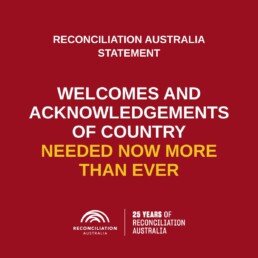
Following the disruptions at ANZAC Day Dawn Services, Reconciliation Australia issued an unequivocal statement condemning the offensive behaviour.
They reaffirmed that Welcomes and Acknowledgements of Country are simple but profound ceremonies, enabling all Australians to participate in a centuries‑old practice of respect and recognition.
Reconciliation Australia noted that such disruptions expose gaps in understanding and education about the true history of this country and that these incidents show why Welcomes are needed now more than ever.
They urged Australians not to back away from Welcomes and Acknowledgements, and expressed appreciation for the many ordinary Australians who responded by applauding Elders at services across the country.
Those quiet acts of respect mattered.
“All In” Reconciliation Is Not a Spectator Sport
Those actions reflect the National Reconciliation Week 2026 theme: All In.
Reconciliation is not passive.
It is not symbolic only.
And it is not the sole responsibility of First Nations people.
For far too long, Aboriginal and Torres Strait Islander peoples have carried the burden of explaining, defending and advancing reconciliation often while being targeted for doing so.
Being All In is not about guilt or shame.
It is about reciprocal responsibility, the responsibility that comes with being Australian.
A Final Word
Welcomes to Country do not weaken Australia.
They do not diminish service.
They do not divide us.
What damages the country is misinformation, cowardice, and the eagerness to silence Aboriginal voices while claiming respect for history.
If we can stand in silence to honour the fallen, we can stand quietly while someone welcomes us, on land that has never ceased being meaningful.
Welcomes are offered in good faith.
The least we can do is meet them with dignity.