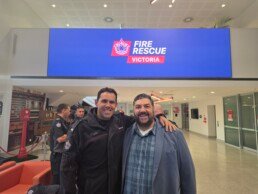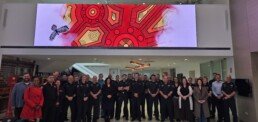
From sketch to screen, this project brings Country into motion transforming First Nations storytelling into a permanent, living presence within Fire Rescue Victoria.
A Legacy Realised: DACC x Fire Rescue Victoria Digital Artwork Integration Launch
There are projects that move quickly and then there are projects that matter.
The partnership between Dreamtime Art Creative Consultancy (DACC) and Fire Rescue Victoria (FRV) sits firmly in the latter. What began as a conversation and introduction through Brett Goodes, has now culminated in a legacy piece: a digital artwork integration that will live inside one of Victoria’s most important public institutions, shaping how people experience Country, culture and identity in the workplace.
At its heart is the From Across the Land animation, a work grounded in First Nations storytelling and expressed through contemporary digital integration.
But the outcome we see today was never about a single moment. It was about the journey. Read the FRV RAP statement here.
Three Years, Built on Trust
As shared by Edvardas Starinskas, the launch represents “the culmination of 3 years of collaboration with our teams.” That timeline matters.
From early conversations with ideation by Fatima and Ed, consulting plans and phased delivery through to animation development, AV integration and final deployment, this project required patience, alignment, and an ongoing commitment from both organisations. Early stages focused on artwork development, animation exploration, and technical planning laying a foundation that ensured the final piece would be culturally strong and operationally sound.
There were adjustments. There were delays. There were moments where the pace of a large public institution meant things took longer than anticipated. There were budget constraints. But at no point did the intent waver. And that is what defines this project.
Not Just an Artwork, it’s a System of Meaning
The final digital integration is more than a visual asset. It is a living acknowledgement.
The animation brings together layered storytelling, Country, fire, connection and community expressed through movement, sound and scale. DACC worked closely with FRV and selected artist Samantha Richards to translate her original sketch into a living digital work, preserving the integrity of story while elevating its reach and impact. The piece is further brought to life through the evocative use of Djirri Djirri voices and song, featuring Mandy Nicholson and Stacie Piper, adding a powerful cultural resonance that grounds the work in language, sound and lived connection.
The work speaks to FRV’s presence across Victoria, the strength of its people, and their role within the broader landscape they serve. It is the anchor to guest arrivals and FRV’s establishment of tone from the top. Importantly, this is not symbolic in the superficial sense. It is embedded into who they are and what they represent.
It is part of the physical and digital environment of the Academy, a daily experience for firefighters, staff, and visitors. It reinforces connection to Country not as a one-off gesture, but as an ongoing presence. It makes the organisation feel welcoming of First Nations staff. That is what integration looks like.
Leadership That Made It Possible
Projects like this do not happen without leadership. The commitment from Jessie Fraser and Edvardas Starinskas was consistent from day one. Whether it was refining language, guiding internal alignment, or navigating the complexity of delivery, their role ensured the project remained anchored to both cultural integrity and organisational context. Their willingness to stay the course despite competing priorities and complexity was critical.
Alongside this, leaders like Graeme Murphy (retired) and John Karfi (facilities) represent the broader organisational commitment required to bring something like this into reality, where culture is not peripheral, but part of how the organisation defines itself and serves community.
A Public Sector Signal: Doing the Work Properly
One of the most important aspects of this project is what it signals. Public sector organisations often move more slowly. Governance, procurement, approvals, these are real constraints with real risks. But what this project shows is that when organisations commit to doing things properly, the outcome is stronger, more authentic, more robust and inclusive.
As noted by Ed during the project, “all things worth doing are worth doing well and at the pace that’s right for the project.”
That approach allowed trust to build. It allowed cultural authority to be respected. And it ensured that the final outcome was not rushed, diluted, or reduced to a checkbox.
A Launch That Reflected the Work
The launch itself carried the same weight as the project. There was a clear sense that this wasn’t just about unveiling an artwork, it was about recognising a shared commitment.
The presence of both Victorian and New South Wales First Nations firefighters reinforced this. It spoke to a broader community of practice, a network of people who carry both cultural identity and public service responsibility. It was great to reconnect with brotherboi Brett Goodes. It grounded the moment in lived experience.
And it reflected the very purpose of the work, to ensure that First Nations culture is not only acknowledged, but embedded within the institutions that serve our communities.
From Integration to Legacy
What stands now at the FRV Academy is not a finished product. It is a foundation and the commencement of journey.
The animation, the digital integration, and the broader system of cultural expression represent the beginning of something ongoing. As noted in post-launch conversations, there is already momentum toward future initiatives, acknowledgement plaques, additional site integrations, and further cultural work across the organisation. This is how legacy is built.
Not through a single deliverable, but through a continued relationship.
Why This Matters
At DACC, we often talk about moving from intention to impact. This project is a clear example of that shift. Fire Rescue Victoria has demonstrated a willingness to embrace First Nations culture not just in strategy or statements, but in lived, visible, everyday ways within the workplace and the communities they serve. That willingness matters. It sets a standard. And it creates a pathway for others to follow.
I’ve always believed that the most important projects are the ones where you hold your line. Where you don’t rush. Where you respect the process. Where you build something that will still make sense years from now. This was one of those projects.
And standing there at the launch, seeing it realised, it was clear: This wasn’t just an integration. It was a commitment made visible.