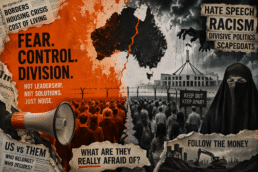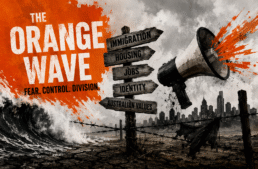
The Orange Wave: Fear, Control and the Politics of Thin Substance.
What this movement is really selling
In my view, the Orange Wave is being presented as if it is some kind of policy breakthrough, but that gives it too much credit. What it appears to be selling is not a coherent governing program so much as a controlled story about pressure, blame and belonging. It takes real national anxieties such as housing, cost of living, infrastructure strain and social uncertainty, and compresses them into one dominant explanation: migration.
That is why it cuts through. It is neat, memorable and emotionally legible. But, in my view, neatness is not the same thing as truth, and simplicity is not the same thing as policy. One Nation’s own policy material frames migration as a central driver of pressure on housing, wages and public services, with proposals to cut intake dramatically, tighten eligibility and withdraw from international refugee arrangements. That much is clear enough.
The problem, as I see it, is that reality is more complicated than the movement’s messaging allows. Research on Australia’s economy shows migration does not only add demand; it also contributes to labour supply, productivity and employment growth. Broader analysis has pointed to positive links between migration, regional productivity, employment and innovation. Other economic commentary similarly notes that migration expands both the workforce and broader economic demand, even while it can intensify housing and infrastructure pressures where supply is already constrained.
In my view, that is the contradiction at the heart of the Orange Wave: it presents one part of the system as if it were the whole system, because that version is politically useful.
Why the migration story matters so much
What, in my view, makes this movement stronger is not only what it says, but what it seems to understand about public psychology. Migration has become more than a policy issue. It has become a vessel for a much larger fear: the fear that the country is changing in ways some people no longer feel able to control.
That is why the argument lands so hard at the centre of the dominant group. It is not simply about numbers. In my view, it is also about who gets to define the national story, whose values sit at the centre of public life, and who is expected to adapt to whom.
I have seen a version of this same pattern in my own domain of Aboriginal affairs. We only have to look back at the consequences of the Voice debate and the way it became a political football. In my view, that process turned a serious national question into a campaign instrument, and in doing so deepened public division and mis-information instead of public understanding.
The Orange Wave borrows heavily from the language of fairness, effort and contribution, but, in my view, it turns those ideas into a sorting mechanism. Instead of asking how economic systems distribute opportunity, or why prosperity has become less secure even for people who work hard, the conversation is redirected into a judgement about who contributes and who does not. It translates structural failure into cultural suspicion. That is why it resonates. It offers not just an explanation, but a hierarchy and, importantly, a question about who gets to create and control the narrative in the first place.
The policy problem they cannot quite hide
If this movement were only about political theatre, it would be easier to dismiss. But it is also trying to look like government-in-waiting, and that is where, in my view, the strain begins to show.
Once the messaging is tested against detail, coherence becomes harder to maintain. Independent summaries of One Nation policy have noted that some of its strongest proposals appear light on implementation detail, including how terms such as “extremist ideologies” would be defined and which migration streams would actually be cut to meet the numbers being promised.
That same weakness was visible, in my view, in the housing policy confusion that unfolded publicly this month. During a live interview, Barnaby Joyce initially suggested permanent residents could be forced to sell their homes under the party’s policy, only to later retract that statement after seeking clarification. Reporting on the issue noted that the party leader then had to step in to clarify that the policy would apply to temporary visa holders and foreign citizens residing overseas, not permanent residents.
To me, the issue here is not one awkward interview. It is the broader pattern it suggests: a movement speaking with total certainty in headlines, then struggling to carry that certainty through a basic explanation of how its own policies would work in practice. This approach doesn’t serve the Australian people and we should demand better and hold to account – please explain!
Spectacle as a substitute for leadership
In my view, that gap between assertion and substance is often filled by performance. One of the clearest examples was the burqa stunt in the Senate, where parliamentary time and attention were consumed by something designed less to advance a workable policy outcome than to dominate the frame.
Reporting at the time noted that proceedings were suspended for more than ninety minutes after Pauline Hanson entered the chamber wearing a burqa and refused to leave after being sanctioned. Senator Fatima Payman described the act as “abhorrent and disrespectful”. Thank you Fatima, for showing strength and resilience to speak out and speak up for those who’s voices might not be heard.
The significance of that episode was not procedural. It was symbolic. In my view, it showed how spectacle can be used to replace depth: provoke, dominate the cycle, present that domination as courage, and move on before the harder policy questions catch up. It also says more about us as people and what we are willing to accept, walk past and normalise.
This is not, in my view, an isolated method. Australia has seen versions of it before, particularly in the way race and ridicule have long been used as cultural tools. The blackface incident involving a member of the Footyshow in 1999 remains one of the better-known examples of how caricature gets repackaged as entertainment in Australian public life. Scholarly work on blackface in Australia has linked that incident to a broader pattern in which blackface reinforced whiteness and social hierarchy rather than functioning as harmless parody.
Different setting, same underlying logic: push the boundary, call it theatre, and dare everyone else to object. In my opinion, these are the same logic as jokes and stereotyping and who pays for the punchline.
The money, the media and the old Australian pattern
There is also, in my view, a deeper Australian story sitting behind all of this: the relationship between political momentum, media power and financial backing.
The documented part is reasonably clear. Media ownership changes under the Hawke–Keating era reshaped the Australian landscape and helped entrench one of the most concentrated media systems in the Western world. Commentary on media regulation has described 1987 as a watershed, and academic work has argued that the reforms advantaged major proprietors and produced a dramatic upheaval in ownership.
That history matters because, in my view, the Orange Wave does not rise in a vacuum. Political movements are not sustained by grievance alone. They are amplified by ownership structures, media incentives and donors who see future value in present momentum.
It is always framed as support at the front end. The harder question comes later: what gets returned, and through which policy settings, concessions or regulatory choices? In my view, that is not some wild conspiracy; it is part of the old logic of Australian power. If a movement is fuelled by people who expect relief from constraints, whether in mining, heritage, regulation or media settings, those expectations do not simply disappear once the cameras move on.
The global echo and the danger of mistaking volume for strength
The Orange Wave is also, in my view, part of a broader global pattern. Across several countries, movements have grown by reducing complex national problems into one emotionally charged story about identity, sovereignty and control. They do well not because they explain the system honestly, but because they turn uncertainty into something concrete and directional. They take fragility and frame it as power.
That is why, in my view, the comparison with Trump-era politics is not superficial. The method is recognisable: grievance framed as truth-telling, policy reduced to posture, and public strength performed through confrontation rather than command of detail. For me, command of detail is something that the current government is doing well, although not perfect, it’s still a workable model for most people in a democratic society.
That is also why leadership quality matters here. A movement that wants to be seen as credible on a global stage cannot rely forever on volume, resentment and spectacle. At some point people start asking whether composure, steadiness and intellectual control are actually present when the pressure is on.
That question is uncomfortable for this movement because, in my view, it has built so much of its identity around projection. But projection is not the same thing as capability. Confidence is easy in a slogan. It is much harder when you are forced to explain the machinery.
What this really comes down to
In the end and in my view, the Orange Wave is not strong because it has solved anything. It is somewhat stronger because it has simplified everything, and packaged into people’s fear and frustration.
It offers emotional clarity at a moment when people are tired, financially stretched and politically disillusioned. It tells a story about control that feels satisfying because it gives uncertainty a target and gives the frustration a language. But that is exactly why it should be treated carefully.
Movements that depend on compression, performance and cultural sorting can rise quickly because they are easier to understand than the systems they claim to fix.
The question is what happens when the slogans meet legislation, when the theatre meets process, and when certainty is forced to survive contact with reality. That is where the Orange Wave still looks thin to me. Not because it lacks confidence, but because confidence is the easiest thing in politics to manufacture. Substance is much harder. And eventually, that difference becomes impossible to hide.