National Sorry Day: why truth is so often resisted, and why we must remember anyway
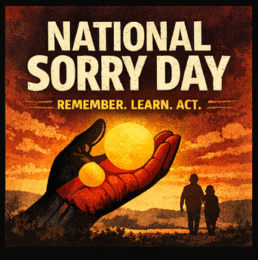
Today is National Sorry Day. It is a day that asks this country to do something many societies struggle to do well: remember truthfully. It asks us not just to acknowledge that harm was done, but to sit with what that harm means, who carried it, who still carries it, and what responsibility remains with the rest of us now. National Sorry Day is marked each year on 26 May to acknowledge the Stolen Generations and to commemorate the tabling of the Bringing Them Home report in 1997, which documented the forced removal of Aboriginal and Torres Strait Islander children from their families, communities and Country, and its ongoing intergenerational impacts.
This is why the day matters. Not simply because it is historical, but because it is living. The report was not abstract. It was built on testimony, grief and courage. The National Museum of Australia says the inquiry heard directly from 535 First Nations people and received hundreds of further letters and testimonies. The Australian Human Rights Commission says the report traced the laws, practices and policies that led to the forced removal of children and made recommendations to support healing and reconciliation.
And yet this is exactly where many societies become uncomfortable. When the truth moves from a neat national story into lived harm, into moral consequence, into systems, institutions and inherited advantage, people often start looking for the exits. They want history softened, edited, shortened, or reframed into something less confronting. They say things like “that was in the past” or “we need to move on” or “why keep bringing this up?” But what they are often really saying is: this truth is pulling me out of my comfort zone, and I do not like what it asks of me.
I think that is one of the biggest reasons countries forget. Not because they do not know, but because knowing properly creates discomfort. It unsettles the stories people tell themselves about innocence, fairness and national identity. It creates a kind of moral and intellectual instability. And many people would rather preserve comfort than undergo the harder work of rethinking what they have inherited.
There is actually a useful way to understand this through learning theory. Educational theory describes cognitive disequilibrium as the mental imbalance that occurs when new information does not fit neatly into what we already believe or understand. It is the moment when something no longer adds up in our current schema. Piaget’s educational theory describes learning as a process involving assimilation, accommodation and equilibration, where conflict or mismatch between new information and existing understanding forces adaptation.
In another tradition, the zone of proximal development describes the gap between what a learner can do independently and what they can achieve with support, dialogue or guidance from others. The APA Dictionary of Psychology defines it as the difference between a person’s actual level of ability and the level they can achieve when assisted by more experienced partners.
For me, there is a strong parallel here with how nations learn or refuse to learn. Truth-telling about the Stolen Generations pushes society into disequilibrium. It disrupts the old story. It exposes that what some people were taught about Australia was incomplete, sanitised, or self-protective. And when that happens, people have a choice. They can resist the discomfort and retreat into denial. Or they can stay in that uncomfortable space long enough to learn something deeper, truer and more adult about this country and themselves.
That is why I do not think truth-telling is just about information. It is about maturity. It is about whether a nation has the courage to move beyond a childlike relationship with its own history. Real learning is not simply adding new facts onto an old myth. Sometimes it requires accommodation, the restructuring of what we thought we knew and what we thought we knew. That hurts. It unsettles identity. We feel challenged and struck. It asks people to admit that what they inherited as “normal” may have been built on Aboriginal dispossession, exclusion, forced removals and deliberate policies of assimilation, and that taboo word, genocide. But if learning is real, it must sometimes disturb us before it changes us.
That is why I reject the idea that remembering days like this is about dwelling in the past. It is not about being trapped in history. It is about refusing to be dishonest with ourselves, our communities and our stories, about how the present was made. The Australian Human Rights Commission says reconciliation requires Australians to recognise and respect First Peoples, acknowledge past injustices and ongoing inequalities, and commit to a more equal and respectful future. That tells us something important: remembering is not separate from the future. It is part of how a future with integrity gets built.
The 2008 National Apology to the Stolen Generations was one significant national step in that process. On 13 February 2008, Kevin Rudd apologised for the laws and policies of successive parliaments and governments that inflicted profound grief, suffering and loss, and apologised especially for the removal of Aboriginal and Torres Strait Islander children from their families, communities and Country. The Healing Foundation describes that apology as the first formal national acknowledgement of that grief, suffering and loss, and an important first step towards restitution and healing.
But the other hard truth is this: acknowledgment without action becomes its own form of failure at a national level. The language of sorrow means very little if the structures that carry the harm are left largely intact. Reconciliation Australia said today that only five of the 83 recommendations from Bringing Them Home have been fully implemented, and that “sorry without action is not enough.” The Healing Foundation likewise says only 6% of the recommendations have been implemented and that time is running out for surviving Stolen Generations members to see justice in their lifetimes.
So when I think about National Sorry Day, I do not just think about remembrance as sentiment. I think about remembrance as resistance; resistance to forgetting, resistance to sanitising, resistance to the national instinct to turn difficult truth into a brief ceremony and then move on unchanged. Because that is what often happens. Societies ritualise memory in order to contain it. They create a commemorative moment but resist the deeper restructuring of thought, policy and accountability that true remembrance demands.
And maybe that is because genuine remembrance does not leave us where it found us. If we really remember, then something has to shift. If we really listen, then the old story can no longer stand as it once did. If we really acknowledge, then we cannot keep pretending the burden sits only in the past. The burden is also in the present: in systems, in inequities, in overrepresentation, in unresolved trauma, in missing records, in inadequate redress, in communities still carrying what others would rather file away as history. Reconciliation Australia noted in 2025 that Aboriginal and Torres Strait Islander children made up 43.7% of children aged 0–17 in out-of-home care across Australia in 2023, showing how past and present cannot be cleanly separated.
For me, that is the strongest argument for why we remember. Because forgetting is not neutral. Forgetting protects the status quo. Forgetting protects comfort. Forgetting protects the people who benefit from distance. But remembering truthfully has the potential to change us. It can move us from fragility to honesty, from defensiveness to responsibility, from symbolism to action. That is the harder path, but it is the only one that has any real integrity.
Today should not be about washing history clean so it can be safely consumed. It should be about allowing the truth to do what truth does: unsettle, teach, humble and call us forward. A mature society should be able to withstand this. More than that, it should want to. Because history is not healed by denial. It is not healed by selective memory. And it is not healed by apology alone.
It is healed, as much as anything can be healed, when we remember honestly, act responsibly, and stop treating discomfort as a reason to look away.