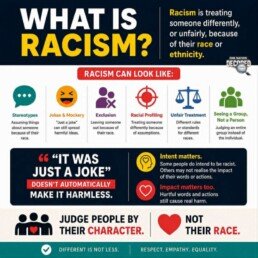
It’s not just a video, it’s a reflection of who we are, and a test of who we’re willing to become.
Cheap Laughs, Deep Fault Lines: Power, Fragility and the Work of Change
Every now and then, something cuts through the noise and exposes where we really are in the modern day Australian story.
The recent circulation of a video mocking Aboriginal people leaning into degrading stereotypes for attention is not just offensive content. It is symptomatic. It reflects an enduring logic about who gets to be diminished, and who gets to do the diminishing.
This is not about one individual. It is about a hierarchy that continues to shape how we see each other.
The Direction of the Punchline: Humour, Power and Permission
Humour is rarely neutral.
From buffoonery and Vaudeville through to modern algorithm-driven platforms, comedy has often relied on exaggeration and caricature. But the consistent pattern is this: the punchline travels downward.
It lands on those perceived to be less powerful, less protected, less able to respond.
When First Nations people are reduced to stereotypes, particularly those that draw on histories of marginalisation, the joke is doing more than seeking laughter. It is reinforcing a social order. It is signalling that some identities remain acceptable targets of reduction.
And importantly, this pattern is inherited. It reflects who has historically controlled the narrative and who has not.
The moment the lens turns upward, however, something shifts.
When humour interrogates dominant groups, whiteness, privilege, structural advantage, the tolerance changes. What was once dismissed as “just a joke” becomes uncomfortable, contested, even unacceptable.
That asymmetry reveals the truth: this has never been about humour alone. It has always been about power and permission.
Fragility, Threat and the Myth of Inherited Position
The discomfort that surfaces in these moments often gets labelled in simplistic ways. But it is worth understanding more precisely.
What we are seeing is a form of fragility, not as insult, but as a condition. A low tolerance for discomfort when long-held assumptions are challenged.
When conversations move toward:
- systemic inequality
- historical injustice
- or diversity and inclusion
They disrupt an older belief system grounded in colonial foundations: the idea that status, place and entitlement are inherited.
That belief is increasingly under pressure.
Across contemporary Australia, new migrant communities continue to demonstrate something different, a strong orientation to hard work, education, persistence, and long-term aspiration. Many take on work others avoid, invest in opportunity, and build their position incrementally. This contrast is confronting.
It exposes the fragility of the idea that status is a birthright. What is often perceived as “losing ground” is, in reality, the erosion of assumed advantage particularly when measured against effort and determination.
This is where fear begins to take shape. Not necessarily fear of others, but fear of losing position in a system that was once more predictable. Let’s not confuse the gift wrapping of this present.
Misreading Change: From Inclusion to Resistance
We are currently living through a period often described as divisive. But much of this division is produced by a misreading of change itself.
Inclusion is read as exclusion.
Equity is framed as disadvantage.
Recognition is interpreted as loss.
This defensive lens shuts down engagement before it begins. And in that vacuum, ridicule becomes a shortcut. Reducing something to a joke avoids having to understand it. It protects comfort.
This is where conversations around DEI often falter, not because they lack substance, but because they are met with resistance rooted in discomfort rather than inquiry. Just think about how Welcome to Country is under pressure from this fragile grouping, and the noise that’s created for their one minute of discomfort and how their lives will never be the same.
The Real Mechanism: Why We Resist Change
To properly understand what is happening here, we need to move beyond social commentary and look at the mechanics of change itself.
Ironically, I was speaking to a friend yesterday who we both completed Leadership Victoria’s Williamson Program together. In his line of work with emergency services and a newer role of managing people which trying to merge two organisations, he is also struck at how hard change is, what people anchor to and how much energy it requires from yourself, meaning how do we manage through change. I floated my wonderings from our daily work at DACC which take daily reminders to clients about change, the ebb and flow and the energy transfer, the resistance to change, and the path of least resistance. It takes me back to my uni days studying a Master of Education (Primary), and to Jean Piaget’s framework which I think offers not only a powerful lens but is the missing piece to change itself if we are to understand it, call it out and scaffold the support needed for the journey itself.
At its core is a tension between equilibrium and disequilibrium:
- Equilibrium is cognitive comfort where our existing schemas, our mental models, make sense of the world and how we interact with it.
- Disequilibrium occurs when new information cannot be explained by those schemas, creating psychological discomfort.
When people encounter ideas that challenge their worldview and schema whether that is acknowledging systemic inequity or engaging with First Nations perspectives, they experience disequilibrium. This discomfort is not failure. It is the engine of development. It becomes a fight and flight response. But it presents a choice.
People can:
- Assimilate: reject or reshape new information to fit existing beliefs, often through dismissal or ridicule
- Accommodate: adjust their schemas, which requires effort, humility, and a willingness to let go of certainty
Accommodation is hard work. It involves cognitive reorganisation rethinking how the world is structured, how identity operates, and how histories are understood. It also asks us to realise those groupings we live in and operate in, our communities and our sense of belonging.
Assimilation, by contrast, protects comfort.
This is why humour, dismissiveness, and defensiveness often appear at exactly the moment where learning is possible. They are not random, they are protective responses to disequilibrium.
Australia carries a long history of assimilationist thinking, formally embedded through government policy from the late 1930s through to the mid‑1960s. This sat alongside, and was deeply connected to, the White Australia Policy, both frameworks grounded in a belief system that privileged European identity as the cultural and social standard.
A telling example sits in a 1947 remark by Arthur Calwell, Australia’s first Minister for Immigration, who defended the White Australia Policy using the phrase, “two Wongs don’t make a white.” The comment, a racially charged distortion of the familiar saying “two wrongs don’t make a right”, captured the underlying logic of the time: that whiteness was not only the norm, but the benchmark to be preserved.
That mindset was not subtle. It was explicit. And for many, those beliefs persist in different forms to this day. It’s the historical hangover, the headache that many of us wake up with and must do the hard work of untangling this legacy, understanding where it lives, how it shows up today, and how it continues to shape the way we think, behave and relate to one another. That starts by sitting in the discomfort of it, recognising where our thinking no longer holds, and being prepared to rebuild how we see the world.
A Society in Disequilibrium: The Current Impasse
What we are experiencing now is not a series of isolated incidents. It is a wider societal condition.
Australia is being asked to reconsider:
- how history is told
- how power operates
- whose perspectives are centred
For some, this leads to growth.
For others, it produces resistance, not because the information lacks validity, but because it destabilises long-held schemas.
This creates an impasse:
- one side pushing toward expanded understanding
- the other retreating toward familiarity and certainty
Until this tension is acknowledged, the pattern will continue including the re-emergence of reductive humour and harmful content. And platforms like TikTok love content that engages.
Beyond Assimilation: Toward Intercultural Maturity
The longstanding model in Australia has been assimilation, the expectation that difference should adjust to fit a dominant norm. Yet, that model is no longer sufficient.
Many conversations with my partner Fatima (Williamson Alumni) these difficult conversations, she always asserted her views on working towards interculturalism, not multiculturalism. She explains this as multiculturalism playing an important role in allowing different cultures to exist and be recognised, but it often stops at coexistence people living side by side without necessarily engaging with one another. Interculturalism goes further. It prioritises active interaction, dialogue and exchange between cultures, recognising that understanding is not built through proximity alone, but through meaningful contact. Where multiculturalism can sometimes reinforce fixed identities and distance, interculturalism treats identity as dynamic, something shaped and reshaped through relationship.
She explains that it asks more of us: not just tolerance, but participation; not just acceptance, but a willingness to be challenged and changed. In this sense, interculturalism creates the conditions for mutual understanding, breaks down “us and them” thinking, and opens the space for real cognitive and cultural shifts, the kind required if we are serious about moving beyond inherited hierarchies toward genuine equality.
What is required is a move toward intercultural maturity:
- where multiple perspectives can coexist
- where difference is engaged, not flattened
- where understanding is mutual rather than hierarchical
This shift demands something more difficult than agreement. It requires the capacity to sit in discomfort without retreating.
To stay in disequilibrium long enough for new understanding to form.
The Work Ahead: From Reaction to Restructuring
Moments like the one we have seen can be responded to quickly through outrage, condemnation, or dismissal. But if that is where it ends, very little changes. Because the real issue is not the joke itself.
It is the need for the joke, the need to reduce, to dismiss, to protect a worldview under pressure.
If there is a challenge in front of us, it is this:
- to recognise discomfort as a signal, not a threat
- to resist the pull back to easy narratives
- to do the harder cognitive work of restructuring how we understand the world
This is not easy. But it is necessary.
Because meaningful change does not happen in comfort. It happens in the tension between what we know and what we are being asked to learn.
And until we are willing to sit in that tension, we will keep returning to the same patterns, repackaged, redistributed, but fundamentally unchanged.