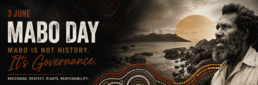
Mabo Is Not History. It’s Governance.
Every year on 3 June, organisations pause to acknowledge Mabo Day. They mention Eddie Koiki Mabo, the High Court decision, and the end of terra nullius. And then, more often than not, they move on. It was 1992, when the High Court recognised that the doctrine of terra nullius was false, affirming that Aboriginal and Torres Strait Islander peoples had always maintained connection to Country. That recognition was profound. It shifted the legal landscape and created a foundation for native title and other forms of agreement-making
But Mabo was never intended to sit quietly in the past. It was not a symbolic milestone, it was a legal reset. In recognising native title, the High Court overturned the fiction that this land belonged to no one and affirmed what Aboriginal and Torres Strait Islander peoples had always known: that connection to Country never disappeared.
If we treat Mabo as history, we reduce it to narrative. If we treat it as governance, we begin to see the distance between recognition and reality.
What Mabo established was not a finished outcome, but a framework, one that required governments, institutions and businesses to change how they operate. That work is still ongoing, and in many cases, it is incomplete.
Victoria has often positioned itself as progressive in this space. The Traditional Owner Settlement Act was designed as an alternative to native title, a faster, negotiated pathway to recognition that reflected a more contemporary approach. On paper, it aligns with the spirit of Mabo: negotiated outcomes, recognition of rights, shared title of parts of crown land, and an emphasis on relationship.
But frameworks are only as strong as their application.
What we continue to see is a gap between design and delivery. Recognition can be fragmented. Negotiation can be constrained. And self-determination can become conditional, shaped more by administrative process than cultural authority.
The tensions that have emerged in Victoria, including those involving my own group Taungurung, point to something deeper than a single issue. They reveal the difficulty of translating legal recognition into lived governance. When questions of authority, representation and legitimacy arise, it signals that systems are not fully grounded in community-held knowledge, legal known borders, family linages, and cultural structures.
Mabo was about land, but its implications extend beyond land into decision-making. Today, the real question is not only who holds rights to Country, but who holds authority over what happens on it. Who can assert sovereignty and custodial rights. Who determines how culture is shared? Who approves its use? Who benefits from the economic activity that flows from it?
In too many cases, organisations continue to operate as if these questions are optional and at best, based on a set of guidelines rather than policies with punitive outcomes. Cultural engagement is treated as a layer, something to be added, rather than as a system that requires governance and front-line involvement. Procurement processes prioritise speed and convenience over legitimacy, relationships and trust. Cultural work is commissioned without clear authority. Intellectual property is used without robust cultural frameworks in place.
These are not minor oversights. They are structural gaps no-one is prepared to look at, amend and do the hard work to create a more robust model.
The legacy of Mabo will not be defined by the decision itself, but by how well we have built systems that reflect it. Right now, that picture is uneven. There are examples of strong, respectful partnerships, but there are also examples where the intent of Mabo has not translated into practice.
As we move forward toward NAIDOC and beyond, the challenge is not to acknowledge Mabo more often, but to operationalise it more effectively. That means shifting from acknowledgement to authority, from consultation to First Nations-led, and from intention to accountability.
Mabo did not close a chapter. It opened one. And until our governance systems fully reflect the recognition it established, we are still living in the space it exposed.